
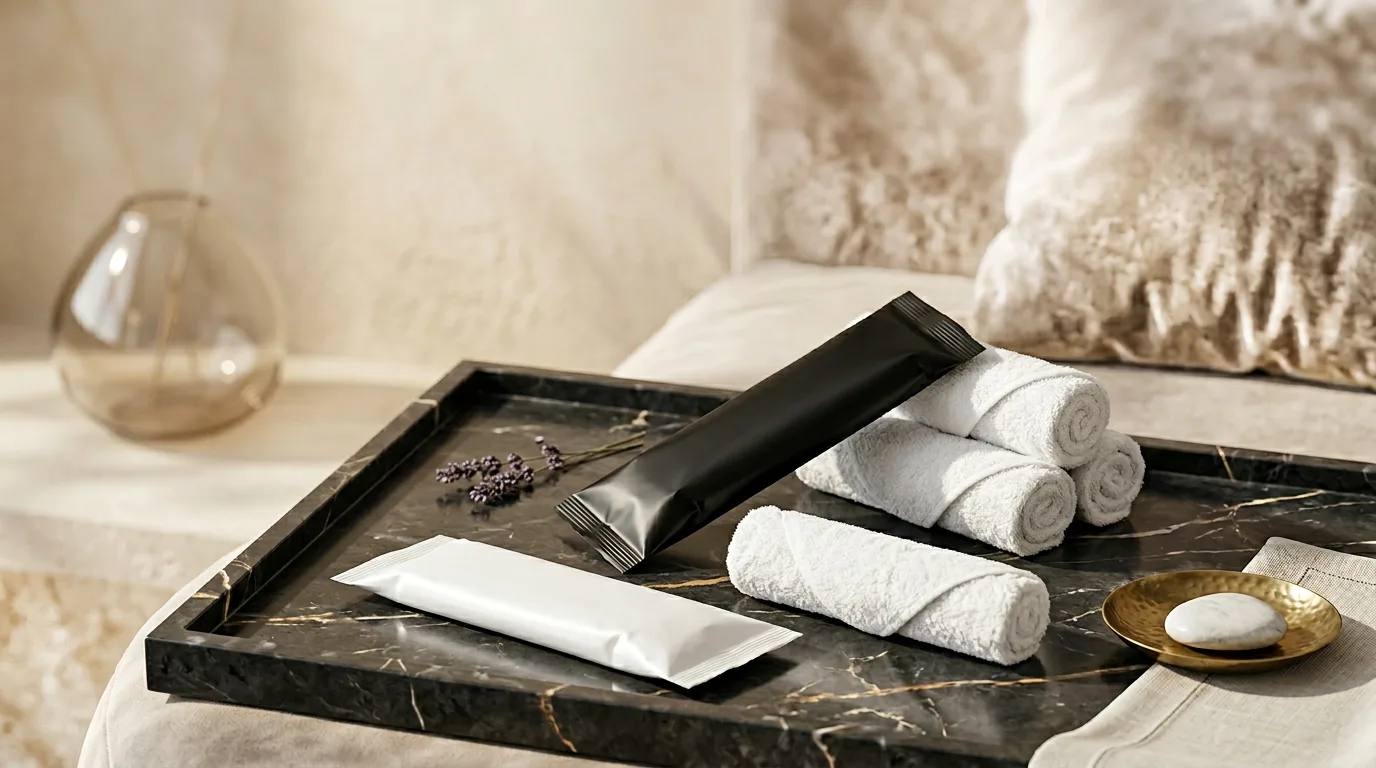
What Is an Oshibori Towel?
A warm or cold Japanese hospitality towel, offered to welcome guests, refresh the hands, and set the tone for the experience that follows.
Definition
What Is an Oshibori Towel?
An oshibori towel is a small Japanese hand towel, dampened and presented to a guest as a gesture of welcome. In restaurants, hotels, spas, and on flights, it arrives before the meal or at check in. Warm in cooler months, chilled in summer. Always fresh.
It is one of the simplest forms of hospitality and one of the most recognised. A guest unfolds the towel, cleans their hands, takes a breath. The service has begun. In Japan, this ritual is so common that it goes almost unnoticed. Outside Japan, it is becoming a quiet signature of brands that take the guest experience seriously.
Origins
Where Did Oshibori Towels Originate?
Oshibori towels originated in Japan. Their beginnings are not tied to a single documented inventor or date, but one commonly cited account traces an early precursor to the Heian period (794–1185). The recognizable practice of wetting, wringing, and offering towels to travelers later developed at inns during the Edo period (1603–1868).
Possible Beginnings in the Heian Period
According to one commonly cited historical account, court nobles during Japan's Heian period are said to have offered moistened cloths to guests. This practice is often described as an early predecessor of the modern oshibori, although it should be presented as a historical theory rather than a definitively proven starting date.
Oshibori at Edo-Period Inns
During the Edo period, hatago inns placed water and tenugui cotton towels near their entrances. Travelers could wet and wring out the towels and use them to clean their hands and feet after a journey. This practice is widely described as the direct predecessor of the modern oshibori service.
The Rise of Modern Oshibori Service
Japan's modern rental oshibori industry expanded around 1955 during the country's postwar economic growth. Specialized services washed, disinfected, rolled, and delivered prepared towels to restaurants, bars, hotels, and other businesses. This made hygienic oshibori service easier to provide at scale and helped establish it as a familiar part of Japanese dining and hospitality.
What Does the Word Oshibori Mean?
The word oshibori combines the Japanese honorific prefix "o-" with the verb shiboru, meaning "to wring" or "to squeeze." The name reflects the original action of soaking a cloth, wringing out the water, and presenting it to a guest.
Oshibori and Japanese Hospitality
Today, oshibori is closely associated with omotenashi, the Japanese approach to attentive hospitality. The towel combines a practical purpose, helping guests clean and refresh their hands, with a welcoming gesture that communicates care before a meal, stay, treatment, or journey begins.
Uses
How Oshibori Towels Are Used
In a restaurant, the oshibori is offered before the first course. In a hotel, it appears at check in or beside the pool. In a spa, it closes the treatment. On a private flight, it welcomes the guest on board. The use changes with the setting, but the intent stays the same.
Guests use the towel to clean their hands or simply pause. In spa, gym, airline and outdoor service, a refresh towel may also be offered for the face or neck when the host makes that purpose clear. The host uses it to mark the start of service, to reset between courses, or to send the guest away comfortable. It is a small ritual that gives shape to the experience.
Temperature
Are Oshibori Towels Served Hot or Cold?
Both. Oshibori towels may be served warm or chilled. In Japan, chilled oshibori are commonly associated with warmer weather, while warm oshibori are commonly associated with cooler weather. This is a hospitality custom rather than a fixed rule, so businesses may choose the temperature based on the climate, venue, service style, guest preference, and the product manufacturer's instructions.
Web Japan, published by the Ministry of Foreign Affairs of Japan, describes Japanese cafés changing their service through the year, offering cold oshibori in summer and hot oshibori in winter. The same seasonal thinking carries into restaurants, hotels, and outdoor venues, where a chilled towel suits a guest arriving from the heat and a warm towel suits a cold evening.
A peer-reviewed study published by the Japan Society of Kansei Engineering examined how the temperature of an oshibori affects perceived comfort. The study tested chilled towels in a 5 to 15 °C range and warm towels in a 45 to 60 °C range. Those figures describe the conditions used in a controlled sensory study of how participants rated comfort. They are not serving recommendations, product preparation instructions, food-safety standards, or guaranteed safe temperatures.
Warm and chilled service are both legitimate forms of oshibori hospitality, and neither is more traditional or more authentic than the other. In a restaurant setting the purpose stays the same at either temperature: cleaning and refreshing the hands before eating. For the etiquette side of the ritual, see our guide on how to use an oshibori towel. Venues choosing a format for regular service can review wholesale oshibori towel options.
Always follow the preparation and safety instructions supplied with the specific product or towel warmer. Do not microwave an individually wrapped towel unless its packaging explicitly states that it is microwave-safe.
Sources
- Web Japan | Kissaten, the Start of Japan's Cafe Culture seasonal cold and hot oshibori service in Japanese cafés.
- Japan Society of Kansei Engineering | Effects of Temperature of Oshibori on Kansei Evaluation controlled sensory study of perceived comfort at different towel temperatures.
- Japan National Tourism Organization | Japanese Customs and Etiquette the traditional use of oshibori for cleaning the hands before a meal.
Format
Cloth vs Disposable Oshibori
Traditional cloth oshibori towels are laundered between uses, often by a dedicated linen service. They feel substantial in the hand, hold warmth well, and carry a sense of craft that disposable formats cannot match.
Single-use oshibori, sealed in branded packaging, solve a different problem. They are consistent, hygienic, and easy to deploy at scale. Airlines, event planners, and high-volume restaurants often choose them for the convenience and the branding moment that the wrapper provides.
Hospitality
Why Restaurants, Hotels, Spas, and Events Use Oshibori
An oshibori is a low-effort, high-impact gesture. A single towel can shift the perception of an entire visit. It signals thoughtfulness, attention, and a standard of care that guests notice and remember.
See how each industry uses it: oshibori towels for restaurants, oshibori towels for hotels and resorts, oshibori towels for spas and wellness, and oshibori towels for yachts and VIP events.
Looking for premium oshibori towels for your restaurant, hotel, spa, or event? Explore our cotton and microfiber oshibori towel options below.
Materials
Cotton vs Microfiber Oshibori Towels
Cotton oshibori towels are soft, breathable, and rooted in the original tradition. They feel warm and natural in the hand, which is why fine dining and spa settings often prefer them. Explore our white cotton oshibori and black cotton oshibori.
Microfiber oshibori towels are durable, quick-drying, and hold scent well. They suit high-volume service and outdoor settings where consistency matters. See our white microfiber oshibori and black microfiber oshibori.
Buy
Where to Buy Premium Oshibori Towels
Our oshibori towels are designed in the USA, individually wrapped, and lightly scented. Browse the full collection, request wholesale oshibori towel pricing, or order custom branded oshibori towels for your business.
Based in South Florida? See our local service for oshibori towels in Miami, with fast delivery to restaurants, hotels, spas, and events across the region.
Prefer to try the ritual yourself first? Read our guide on how to make an oshibori towel at home, with a step by step method for how to make a hot towel at home using a microwave, kettle, or steamer.
FAQ
Frequently Asked Questions
For Hospitality
Talk to Our Hospitality Team
Hotels, restaurants, spas, and event teams: share a few details and we will follow up with samples, pricing, and custom branding options.
Bring the Tradition to Your Space
Premium oshibori towels for hospitality, designed in the USA. For your restaurant, hotel, spa, yacht, or event.